
Human resources management is not just an administrative necessity: it is a strategic lever for the company’s long-term survival. At the heart of this management lies control over the real cost of each employee, a figure that goes well beyond the gross salary alone. How can you determine the total cost of a hire, and with which tools? Here is a breakdown.
Total employer cost: what are we talking about?
The main contributions borne by the employer are:
- the social security contributions (sickness, maternity, disability, death);
- the family allowance contributions;
- the compulsory supplementary pension contribution (AGIRC-ARRCO);
- the unemployment insurance contribution;
- the autonomy solidarity contribution (CSA);
- the accidents at work contributions;
- the payment to the National Housing Assistance Fund (FNAL);
- the AGS contribution (wage guarantee);
- where applicable, the social package levy (forfait social).
Good to know about the supplementary pension: the AGIRC-ARRCO contribution is split between the employer and the employee at 60 % for the employer and 40 % for the employee. It is therefore the employer who bears the larger share.
The “hidden” costs not to forget
An employee’s cost is not limited to charges. For an accurate calculation, several often underestimated items must be included:
- Recruitment costs: job adverts, agency, time spent on interviews.
- Perks and benefits: benefits in kind (company car, phone and so on) and social benefits (health insurance, death and disability cover, employee savings).
- Training and development: skills development and continuing training.
- Equipment and supplies: computer, software, workstation, office space.
- Additional costs: bonuses, end-of-contract pay and so on.
These elements can represent a significant share of the real budget, especially during the first year (recruitment + onboarding + equipment).
From gross to net: the employee contributions
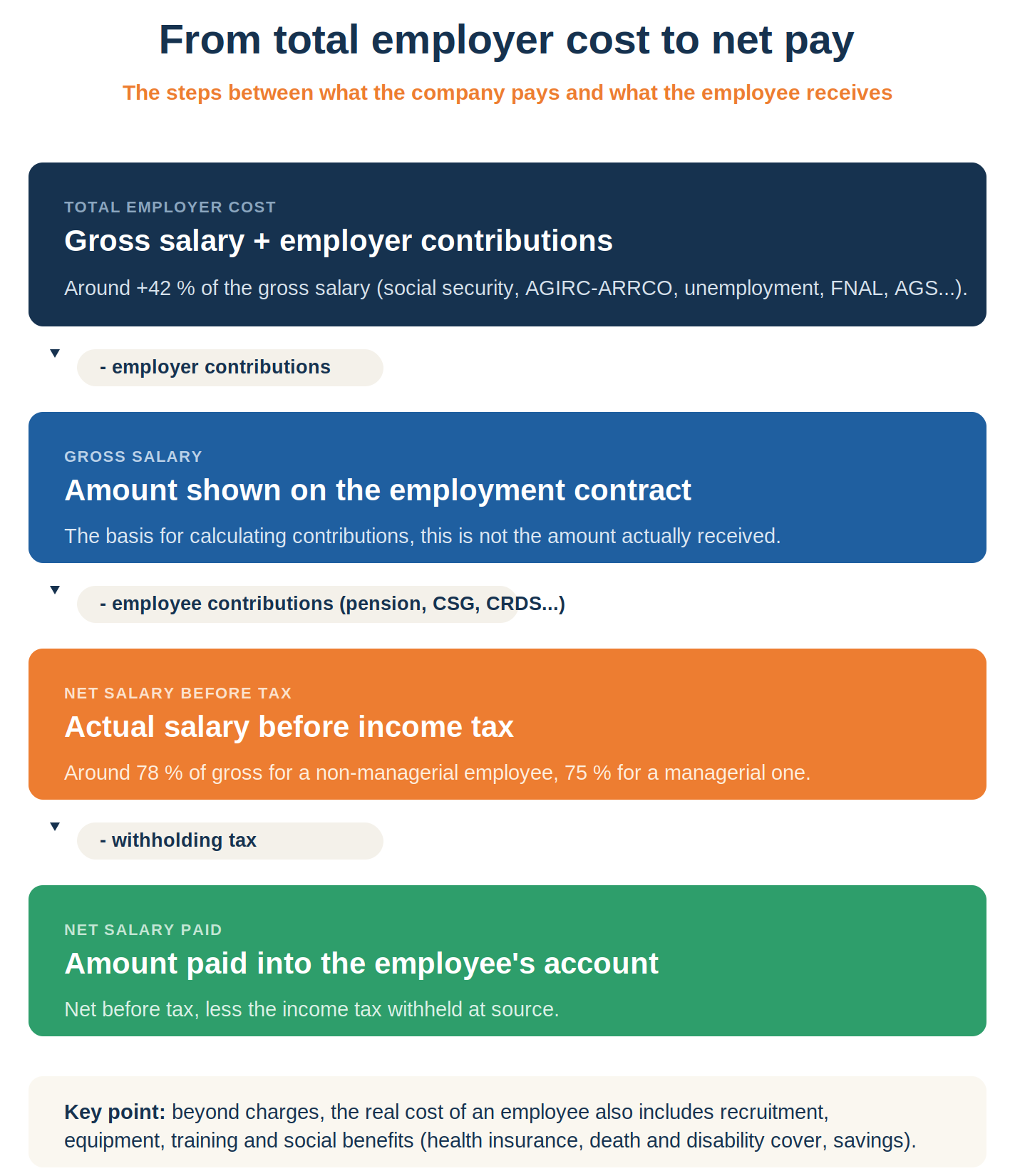
The gross salary shown on the contract is not the amount actually received. From it are deducted the employee contributions, collected at source, which fund in particular the pension, social security, the CSG and the CRDS. The result is the net salary before tax, to which the withholding of income tax is then applied.
To understand this mechanism in detail (managerial/non-managerial ratios, worked examples), see our dedicated article: How to convert gross salary into net salary?.
How to calculate an employee’s cost in practice?
Several free tools make it possible to estimate the real cost of a hire. The most reliable remains the official URSSAF estimator, which calculates the contributions from the gross salary and the status. For a simulation, go to the URSSAF contributions estimator. Private simulators also exist, but always check that they are up to date with the rates in force.
Social protection: a cost, but above all an investment
The total cost of an employee is far from negligible, but part of this spending is a genuine differentiating asset. Offering solid social protection (health insurance, death and disability cover, supplementary pension) represents a cost for the employer, but it is also a powerful lever for employer brand, appeal and retention, often more effective than a simple pay rise, because these schemes carry low social charges.
MIA Assurances supports you
Sizing an employee’s cost correctly also means optimising the “social protection” part of this budget. As a specialist insurance broker, MIA Assurances supports VSEs, SMEs, mid-cap companies and foreign companies established in France in building attractive and well-managed social benefit packages.
FAQ – An employee’s cost
- How can you quickly estimate an employee’s cost?
Count around 42 % in employer charges on top of the gross salary. A gross salary of 3,000 € therefore represents a cost of around 4,260 €, excluding ancillary costs (recruitment, equipment, training).
- Which costs are often forgotten?
Recruitment costs, equipment, training, benefits in kind and end-of-contract pay, which are added to the social charges.
- Who pays the AGIRC-ARRCO supplementary pension?
It is split 60 % for the employer and 40 % for the employee.
- Where can you calculate the cost of a hire for free?
The URSSAF contributions estimator is the reference tool, up to date with the official rates.
- Do health insurance and death and disability cover count in the cost?
Yes, they are benefits to be included in the total cost, but they carry low social charges and strongly enhance employer appeal.